

Cranial Helmets and Plagiocephaly Treatment in Adelaide
Worried about a flat spot on your baby's head? Our orthotists offer fast, comfortable 3D head scans and custom 3D printed cranial helmets, with support every step of the way.
Does your baby have a flat head?
It’s common for babies to be born with, or quickly develop, an uneven head shape or a flat spot. It often becomes noticeable in the first few months of life. This is known as plagiocephaly or brachycephaly, and it’s sometimes called flat head syndrome.
- Plagiocephaly: a flat spot at the back and side of the head, with a bulge at the forehead or the opposite side of the head.
- Brachycephaly: flattening across the back of the head, making it look short, wide and tall.
An uneven head shape has little to no impact on how a baby’s brain develops, but it can be worrying for parents. A 3D head scan tells you how significant the asymmetry is, and whether a cranial helmet, repositioning or simply monitoring is the right next step.
What is a cranial helmet?
A cranial helmet, also called a cranial orthosis or cranial remoulding helmet, is a lightweight, custom-made helmet worn by babies with plagiocephaly or brachycephaly. It fits closely over the higher, rounder areas of the head and leaves a small space over the flat areas. As your baby’s head grows, that growth is gently guided into the flatter areas, so the overall head shape becomes more even and rounded.
At NovitaTech, every cranial helmet is designed from your baby’s own 3D head scan and made on a 3D printer, so it fits your baby’s head exactly.
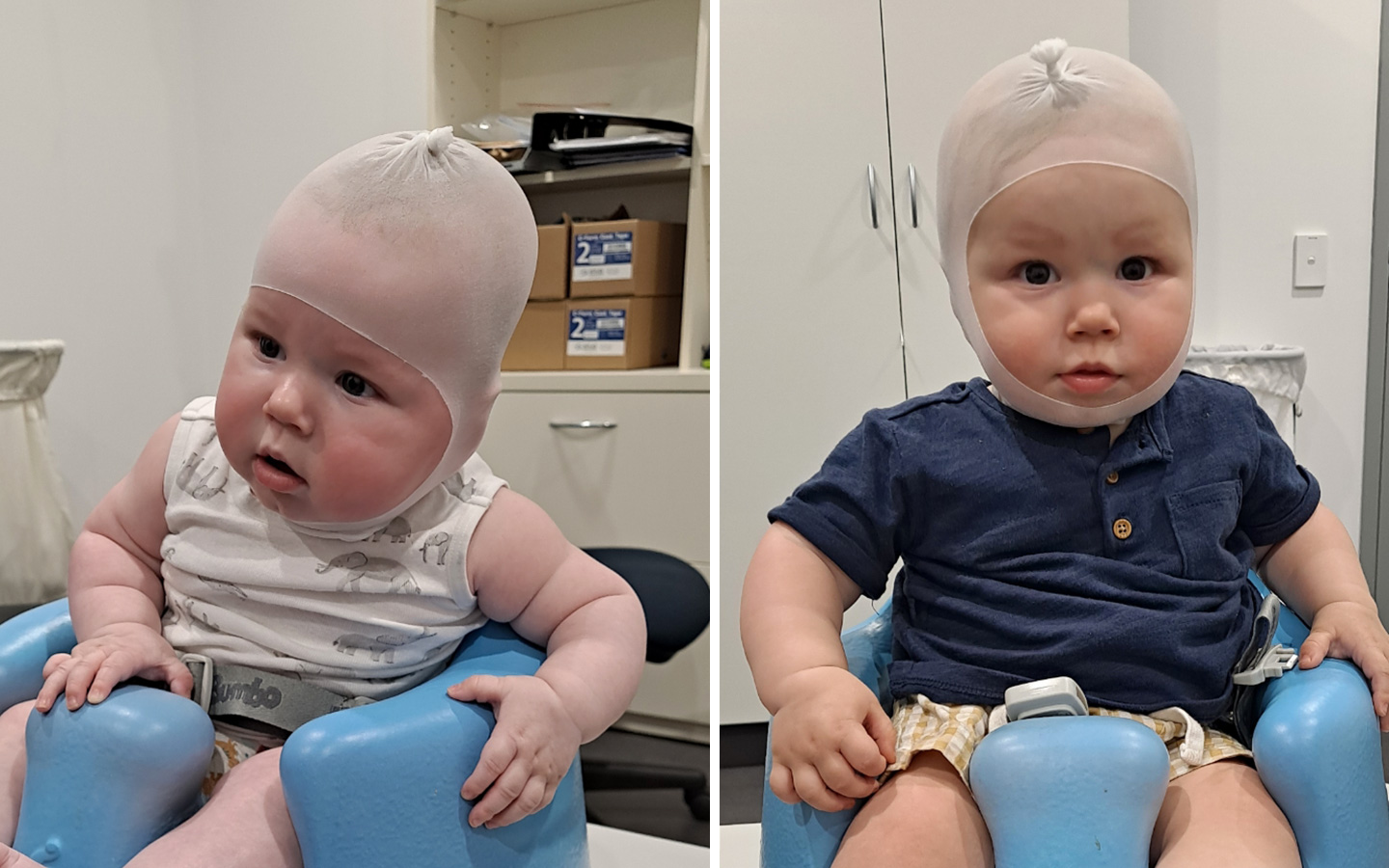
Fast, comfortable 3D head scans
NovitaTech’s cranial service uses a hand-held, non-invasive 3D scanner that captures your baby’s head shape with a safe blue light. It’s quick and comfortable for babies.
Our experienced orthotists use the scan to measure and classify your baby’s head shape on a number scale. This gives you an objective, repeatable measure, so you can see whether treatment is needed and track changes over time.
70% of the time, families find after the first scan that the asymmetry is less significant than they expected, and one appointment is all they need for peace of mind.
Who might need a cranial helmet?
Not every baby with a flat spot needs a helmet. Many head shapes improve with time, repositioning and neck exercises. Your orthotist may talk with you about a cranial helmet when:
- the 3D scan shows a more significant asymmetry
- your baby is in the ideal age range for helmet therapy, around 4 to 10 months, while the head is growing quickly
- repositioning alone isn’t expected to be enough, or hasn’t improved the head shape
We explain the evidence behind each option and what you can expect, so you can make an informed decision for your family. There’s no pressure to choose a helmet.
Your options after the scan
- Monitoring: follow-up scans every month or two to track your baby’s head shape as they grow.
- Repositioning and neck movement: we work with you and other health professionals, such as your physiotherapist, on repositioning and improving neck range of motion.
- Cranial helmet therapy: for some babies, a custom helmet can guide head growth into a more even, rounded shape.

Custom 3D printed cranial helmets
Each cranial helmet is custom made on a 3D printer from your baby’s scan. It fits closely over the high spots of the head and leaves room over the flat spots, redirecting growth to the flat areas to improve the overall shape.
- Lightweight and breathable
- Removable, washable organic cotton liners
- Ideally used for babies aged 4 to 10 months
Helmet therapy is a family commitment. The helmet is usually worn 23 to 24 hours a day until you’re happy with the head shape or your baby outgrows it, with regular re-scans to track progress.
How cranial helmet treatment works
- Book a head shape assessment. Call us or send an enquiry below, and we’ll let you know if you need anything before the appointment.
- 3D head scan. A quick, comfortable scan with our hand-held scanner. We measure your baby’s head shape and talk you through the results at the appointment.
- Decide together. We explain your options, including monitoring, repositioning or a cranial helmet, and what each involves.
- Helmet design and fitting. If you choose helmet therapy, your baby’s helmet is designed from the scan, 3D printed and fitted by our orthotist.
- Regular reviews. We check the fit and re-scan regularly to track progress, adjusting as your baby grows.
- Finishing treatment. Treatment ends when you’re happy with the head shape or your baby outgrows the helmet.
Cranial helmet or repositioning?
| Monitoring and repositioning | Cranial helmet therapy | |
|---|---|---|
| Often suited to | Milder asymmetry, or younger babies | More significant asymmetry, ideally from 4 to 10 months |
| What’s involved | Positioning changes, tummy time and neck exercises, often with a physiotherapist | A custom helmet worn 23 to 24 hours a day |
| Tracking progress | Follow-up 3D scans every month or two | Regular fit checks and re-scans |
Cost
The cost of a cranial helmet depends on your baby’s needs. We’ll talk you through costs before any treatment starts. Contact us or call (08) 8424 6160 for current pricing. If you have private health insurance, it’s worth asking your fund whether it covers cranial orthoses.
What families say
“From the scan and report provided that day, we were able to make an informed decision about helmet therapy.” Avalon, Carter’s mum
“The NovitaTech team was very reassuring. As a parent you have a lot of doubts and concerns… all the information they provided was correct and everything was just reassuring.” Anna, Oliver’s mum
Read Carter’s cranial helmet story and Oliver and Owen’s stories.
Cranial helmet and plagiocephaly FAQs
What is a cranial helmet?
A custom-made, lightweight helmet that gently guides a baby’s head growth into the flatter areas, improving an uneven head shape caused by plagiocephaly or brachycephaly.
Is plagiocephaly harmful to my baby?
An uneven head shape has little to no impact on how a baby’s brain develops. Many families seek advice because of how it looks and the worry it causes.
What age is best for a cranial helmet?
Cranial helmets are ideally used for babies between 4 and 10 months old, while the head is growing quickly.
How many hours a day is a cranial helmet worn?
Usually 23 to 24 hours a day. It comes off for bathing and cleaning.
How long does cranial helmet treatment take?
It depends on your baby. We re-scan regularly to track progress until you’re happy with the head shape or your baby outgrows the helmet.
Is a cranial helmet comfortable?
Our helmets are lightweight and breathable, with removable, washable organic cotton liners, and are made to fit your baby’s head from their own scan.
Does the scan hurt?
No. The hand-held 3D scanner is non-invasive and uses a safe blue light. It’s fast and comfortable.
How much does a cranial helmet cost?
It depends on your baby’s needs. Contact us for current pricing. We’ll always discuss costs before treatment starts.
Do I need a referral?
Contact us to book a head shape assessment and we’ll let you know what you need.
Who will we see?
Our experienced orthotists. Learn more about our orthotics service.
Book a cranial helmet assessment
Worried about your baby's head shape? Send us a message and our cranial team will be in touch. Prefer to talk? Call (08) 8424 6160.